Tuesday, December 31, 2013

Brotherly Love


Hey everyone! So I'm doing a post that to everyone might seem like something simple, but every brother sibling knows. Its brother fights and in my family it's a fight on the next level.

Now if you didn't know, my brother and I both learned martial arts when I was around 10, and ever since then our normal brother on brother fights have never been quite...simple. We both learned Kajukenbo, which became my transition art to Jiu-Jitsu, and now our brawls have evolved into body shot and grappling on brotherly love level. Its starts like a regular moment, but then (for example) when my brother asks me for a pen...and I chuck it to him...It's ON!
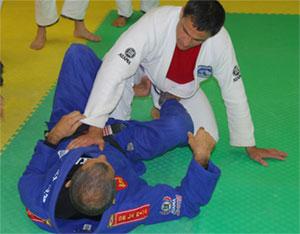
 So the first picture is a classic example as to what happens when I fail a double leg takedown. He grabs my legs flips me and trows me on the floor. The Second picture shows my back given to him and there he has a figure four leg formation on my waist to constrict my breathing he tried to get a rear naked choke, but he failed...I think. The third picture is of i successful rear naked choke on me. I asked him two things here, is it better to tuck in your chin in that position or is it better to turn left (in my case)(away from the elbow).


These fights aren't serious melees, but to use its a way to show each other what we've learned from the East and West Coast. My Brother trained in his own dojo in New York near Chinatown with his instructor who actually trained with Grandmaster Helio Gracie. From there he's fought blue belts and purple belts and been actively used as an example for his class. Likewise for me, I train in a Gracie Certified training center in which my main instructor, Jorge Balares, goes and trains in Torrance every weekend with now Grandmaster Rorion Gracie.

These brawls are what we long for and its rare for a day to go by without any Jiu-Jitsu practiced in on choke or another. Later on either tonight or tomorrow morning i'll try and post a video of us rolling from some time ago.

Now, I leave you with a pic I found on Pinterest....Get it? :D


Happy New Year Guys : )

Friday, November 22, 2013

Blog 9: EQ

1.   Review this.
  • Provide a framework for studies (It calls for breadth and depth of research, Is not a yes/no question)
  • Takes a stance (Allows you to argue some point, Cannot be a recitation of facts or a list)
  •  Format (It is specific, The wording makes sense)
-"I have reviewed the rule of three for writing an EQ"

2.  Review the following EQs and
  • Tell us if it meets the rule of 3 criteria.
  • Tell why it does or why it doesn't
a.  What is the most important factor in healthy weight loss?
-I believe this is a good EQ, it allows the student to revolve his research around the idea of weight loss and only on that. It does give him freedom to research possible answers to which he can develop his own arguable answer but the wording of the question limits him to only one, very detailed answer.Also the wording is much like all the other Senior project and Senior team EQ's ive seen before.
b.  What is most important to securing a conviction in a criminal investigation?
- I feel that this has the potential to do well, and i see where it's trying to go but, the problem i see is that criminal proceedings are already done in a certain format; they cannot be changed for certain people. Also i dont know what the question is asking, is it asking what is most important to the suspect, or for the team of the prosecution? I think this is too specific of an EQ and limits the students ability to research more items to make a stand.
c.  What is most important in creating a hairstyle that best satisfies a customer?
- Im perplexed because it seems like a good EQ but i don't know if it is, The wording seems nice, and i am able to see what the question is asking. It does ask for a specific answer at the end of the whole question, but i guess the problem i see would be the framework for studies. There aren't really a set book or source on how to please customers in hair dressing. The problem i see is that the research will be too vague on variations of hairstyles instead of the physcology of how a customer gets pleased after getting a service done (in this case, the hair-do).
 d.  How can an Anesthesiologist best treat chronic pain?
- I don't think this is a good EQ, With today's medicine, there is already a norm of pain relief (Advil Tylenol) and for many, this is already considered great for them because it does what everyone wants and does so with convenience. Also i feel that their research will be limited too much with few amounts of variables in their question to define. Also the wording isn't asking for the best remedy, but he is asking for what is the best way to administer that remedy.

3.  Based on your review of the rule of 3 and your experience with assessing four EQs, please write another draft EQ for your senior project.
-Well my current EQ,"What are the best ways to "Not Lose" in a controlled environment" and upon reviewing these criteria i will slightly change the wording because that is what i feel weakens my EQ....My topic and idea of focus is there but it isn't as clear as it could be. "What is the most important factor to "Not Lose" in a controlled environment" will be my somewhat edited EQ.

Thursday, October 31, 2013

Positional Control. What I wanted to explain...but couldn't.

Hey Everyone! Yes its that time for the extra blog post so tonight I thought that i would explain what I failed to go in detail about in my 10 minute lesson plan. If you weren't at my presentation, I covered history using the difference in philosophies of different martial arts. Using that, I explained Jiu-Jitsu's creation, effect in modern day, and my mentorship. After that slide I had information about positional control, but it was there where I only had one minute to wrap up my presentation so...tonight for this post I will teach you the positional control that are most essential and even show you a new advanced positional control that I learned last week called the Delajiva Guard.

(Blue) Standard closed Guard
My first primary positional control I believe is most important is The Guard. With variations of Rubber-Guard, Spider-Guard and High-Guard this position is very much adaptable to any situation or advantage you've been given. Now this I believe because like I said in my presentation, Jiu-Jitsu's main focus is ground fighting, with that said the most probable spot you will land your body in will be The Guard; on your back with your legs either open, closed around his body or feet planted on your opponent's hips. This is considered a defensive position as your leg's control over his body and hands are your only protection between his full body control and the punches he may throw over you. From here the defender has many options, he may elbow escape through the fish hook technique or if he's daring he may even bypass the risk and go straight into attack from guard which include the dangerous triangle choke from Guard and arm-bar from the Guard. Either route, this technique is most ideal for me, since I have long and flexible legs, this is my main position. I feel in control of my opponents body and is useful for me to stay strong to the philosophy of "not lose".

(Blue) Standard Mount
My next Position of interest in The Mount a position of total dominance over an opponent and weakness of the victim. With other sects of the position that include high mount, half-mount and side mount generally every sect displays a prominent dominance over the other. Here the victim is at a loss of control. In a street fight, an attack in mount would relentlessly punch and without any hip or arm control the person under has no defense but his hands to defend his face and exposed body parts. The only way to get out of this is to somehow get out though his knee control by elbow escape and achieve the guard control like stated up top. From here, if the attacker, you are, at this point, BLESSED with dominating options. Armbars, Americanas, Kimuras, Ankle Locks, Chokes, and direct access to punch the face is at hand leading a almost solidified victory. I for one do not like mounting an opponent, i feel uncomfortable as i am lightweight and don't feel i have a solid base to keep my opponent in mounted control. Mount is ideal for heavier practitioners to make this their "go to" position because their weight adds to the force of their attacks and also adds extra resistance to the ability of the mounted to escape.

With both the Guard and mount providing an offensive and defensive background, you can probably find out which one is good and which one is bad. These positions were the first i learned in order to even think about doing anything else and even with my 5 years of knowledge with these basic positions, i haven't mastered them...not even close man...Besides the fact that these are the most basic, i showed you all these tonight because i feel that these two are the base of Jiu-Jitsu the base of positional control and in order to learn what i learned last week, the Delajiva Guard, i needed to have an adept understanding of how to use both positional control to my advantage.

Without Further ado i want to show you the Delajiva Guard, an advanced positional control that i learned last week from my mentor that varies much from two positions, butterfly and combative guard. the idea for the Delajiva guard was rooted in neutrality and power given to the user to flip the fight in their favor. Its a sneaky position, where the users left left hooks under the opponents right leg and then uses their right leg and posts it on the opponent's hip. I tried using it and didn't get an understanding of the move at all. In fact i thought wow this is a stupid move why not just go into regular guard? While this control does require more energy and a more complex position, i found that i guarantees positional control in your favor...whether you lose that given position is up to you but for the moment it will take you where you want to be. From here, i took the leg hook and leg post concept and played around with the idea while standing up and to my surprise, is an actual sweep the my instructor showed me a day later. Over all this is what I've been playing with and is a position i will be using a lot.

Check in again soon as within the next two weeks i will be sparring with another one of my friends who does Jiu-Jitsu as his senior project as well and we will be providing both sides of our roll against each other...Thanks!
Wednesday, October 16, 2013

Blog 8: Research and Working EQ

1.  What is your working EQ?
-My current working EQ would be, "In what ways can one prepare themselves, physically and mentally, for a combative Jiu-Jitsu fight?"

2.  What is a possible answer to your working EQ? Please write the answer in thesis format.
-Having the maximum understanding of your Jiu-Jitsu arsenal; Being proficient in maintaining the current of the fight on your side in all positional controls (Guard, Mount, Side Control etc.) and building submission combos as a reflex with fall back techniques in case of failure.
-Building your body to peak fitness level; Train yourself with cardio workouts-controlling your heart rate and breathing means harnessing one factor, that if uncontrolled, can add another element of stress to the fight. Also focus on fueling your body with the best diet, it will keep your body energized at a maximum level.
-Prepare your mind for the haze of combat, Ex. practicing with your eyes closed: It forces your body to concentrate on it's limited senses without factoring the uselessness of obscured vision also it forces you to build a more nimble coordination. On top of this it trains your mind against the psychological effects of being in the middle of a fight.

3.  What is the most important source you have used that has helped you come up with an answer to your working EQ? 
-Honestly, mostly all of my sources have been equally as helpful developing an equally important answer per source, "The Gracie Diet" book showed me the importance of diet in bodily performance and its effect it can have in a fight and personally i have started this diet just this week. "Mastering Ju-Jitsu" enlightened me to Grandmaster Helio's principle theories of Jiu-Jitsu and because of that i have been able to use principles of patience actively and better myself in training. And "Gracie Submission Essentials" opened my eyes to selected moves by the grandmaster and his son that they considered essential, some moves which i haven't even learned through my mentor and has resulted in some victories during training. However, if i was to choose only one i would have to go with my first source, "Mastering Ju-Jitsu." It was a source that showed me not only theory but also included some visual breakdowns of techniques and even inferred to some outside source ideas to which even led me to "The Gracie Diet." It also holds key information that i look back at.

4.  Who is your mentor, or where are you volunteering, and how does what you are doing relate to your working EQ?
-My Mentor is George Balares, a Gracie certified Jiu-Jitsu instructor and avid practitioner of many martial arts mainly focusing on Jiu-Jitsu. For mentorship, i learn as a student in his class and as a student of jiu-jitsu, what other way is there to get better than to actually practice...and that's what i do; train. It relates to my working EQ because i mirrored my EQ to what i focus on everyday in training; becoming a better Jiu-Jitsu practitioner. Not only can i apply theory that i learn from my research but i can also practice any technique introduced in there as well and during "Open Mat", a time designated for sparring and practicing with all you know. Jiu-Jitsu allows me to reflect on what my focus is as a practitioner and translate any experience into knowledge for my senior project.

Thursday, October 3, 2013

Independent Component 1 Approval

1.  Describe in detail what you plan to do for your 30 hours.
-Well, as i am doing covering the topic of Jiu-Jitsu for my senior project, my only form of applying my skill is to actually practice in my class. This includes learning my daily lesson my mentor gives and actually applying it by sparring/rolling on my friday "Open Mat" class where the whole class is dedicated to fighting each other. I will be doing this as both my mentorship and Independent, switching off on hours.

2.  Discuss how or what you will do to meet the expectation of showing 30 hours of evidence.
-Photographs will be my main source of evidence. Also, every day i go into class, there are attendance cards the instructor signs which basically prove i was practicing on those certain days. A copy of course would be shown as evidence. Videos can also be a source, as in December i will be eligible for promotion in which i must send in a video to the Torrance academy showing my growth in the practice.

3.  And explain how what you will be doing will help you explore your topic in more depth.
-Jiu-Jitsu isnt a topic that can only be studied in factual and literal books. The art is an applied art and thus in order to better yourself, you must practice. Thinking about it i think that my independent component will help me as a Jiu-Jitsu practitioner more than any research i can view or book i can read. The plus side to this component is that through my application of techniques i can look up research on the Grandmaster's theory regarding that technique or general tips from that position.


Monday, September 30, 2013

My First Experience To Gracie Jiu-Jitsu

In the Academy, many family heirlooms and records
are showcased....i just couldn't help myself there.

Come on in! Today I'll show you my first experience to Gracie Jiu-Jitsu and how I got to learn from the masters of the US in GJJ; My tour of the Gracie Jiu-Jitsu Academy in Torrance, California from my Sophomore year summer vacation.

Immediate bloodline of the Gracie Family
 in display at the Torrance museum.
My exposure to the art began much before this, something I'll explain in another blog post through my training in Kajukenbo, but as a summer trip, my brother decided to surprise me and take me to the US headquarters of the GJJ Academy in Torrance, a mere 40 minute drive from West Covina. There we were astounded. As we we walked in, we felt like we were in the house of Gods, Jiu-Jitsu Gods. We tour the family museum, which held archives of the art's roots, relics like the first UFC championship trophy, which was won by the Grandmaster's son, Royce Gracie and much much more. The family timeline, which was too grand to fit in the proper honor it should is confined to a tiny frame. In fact here it is to the right. Then after having our historic minds boggled, as we leave we get confronted by two men, older men that looked like Jiu-Jitsu fanatics, little did we know that these two men were 3rd generation GJJ masters, Ryron and Ralek Gracie. In disarry, we were taken aback even more when an invitation to get lessons from them followed after quick small talk about where we train and our martial art background. We then followed in amazement, we were about to get a one hour lesson from masters, all in a day we only expected to take a couple of pictures and buy some souvenirs in...The lesson began, every moment a blur for us as we were amazed at this opportunity and when the lesson was over the memory was even more a blur... Afterwards both the brothers and us stood in the lobby, talking, enjoying our presence with them and asking them questions that our instructor at home couldn't answer with such a perspective. It was a good day, and a day I will never forget.
My brother, Ryron Gracie, and 10th grade me
My brother, Ralek Gracie and 10th grade me


Now the reason for this blog post wasn't to reminisce on a past adventure but grow from it. From that trip, I have advanced to a 3rd stripe white belt only one stripe away to become a Blue belt and be able to learn through the Master Cycle, and advanced GJJ training program. I have learned through experience and continue, everyday I train, roll with my peers and try and learn from every sparring session. I know that I can't achieve perfection in a year, but through the research I am doing, my understanding of Grandmaster Helio's theories, and my continual growth of Jiu-Jitsu through my Senior Project, I will be, in all, a better fighter than with any year I could've dedicated without this project. I was to go to the Torrance Academy again with peers from my Center in La Puente but I unfortunately wasn't able to go thus I shared with you my story of when I last went.

One last thing I will say...When my brother and i left the Academy that day, the Gracie brothers gave us both car stickers bearing the GJJ insignia, a symbol of brotherhood and family in our system. This week we put it on our family car and it looks great but besides that fact, I will leave you with a video posted from the Gracie Academy featuring Rener Gracie, the brother of the other brothers we met, showing how to place this decal on the window of your car. We used this to properly place ours, but, this isn't just a tutorial on placing a window sticker. Instead i show this to you because i found this comical, if you analyze the video you'll find a lot of what I say on my project to reflect his mindset, it's all the Gracie way and overall this video is one I find to give of Jiu-Jitsu humor. Again, if you don't get the humor...Do some Jiu-Jitsu you'll get it then. Enjoy.

Wednesday, September 18, 2013

Blog 6: Second Interview Questions

1.  Who is your mentor and where do they work?
-My mentor's name is Jorge Balares, He is actually a Chiropractor and has had much background in the works of Kinesiology. He is a private Chiropractor but as a side job, or what he likes to refer to it as a "hobby with benefits," he owns his own Gracie Certified Training Center in La Puente where there, he teaches what he knows to his students below him.

2.  What five questions will ask them about their background?
1)-In your childhood or young adulthood, whether it involves you or someone else, what physical altercation has made a direct impact on your life?

2)-What martial arts do you have as background?
2a)-How many years?

2b)-Why those arts?

3)Who are your mentors? And what do you see in them to follow in their footsteps?

4)What is your goal from being an instructor? Of all activities on your spare time, why teach GJJ?

5)What about Jiu-Jitsu has captivated you to dedicate so many years to the practice and also be an instructor of the art?